Dr Peter Magubane, a photographer whose images documented the cruelties and violence of apartheid, drew global acclaim but punishment at home, died on Monday. He was 91.
His death was confirmed by family members. No other details were provided.
His photos included beatings, imprisonment, and 586 consecutive days of solitary confinement.
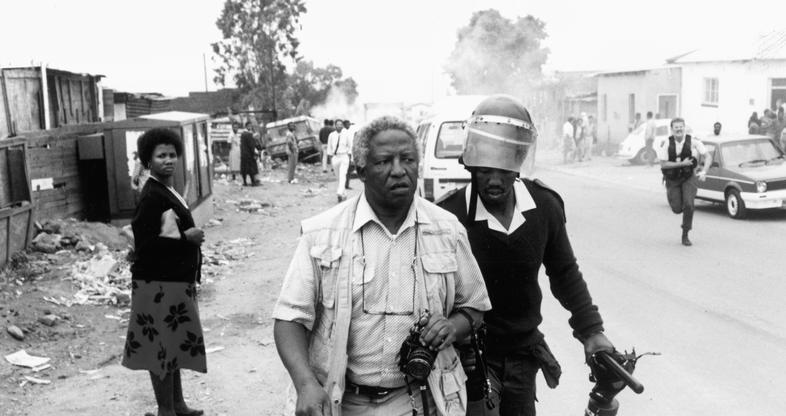
Magubane was famous for hiding his camera in hollowed-out bread loaves, empty milk cartons, or even the Bible. This enabled him to shoot pictures clandestinely.
“I did not want to leave the country to find another life,” he told The Guardian in 2015.
“I was going to stay and fight with my camera as my gun. I did not want to kill anyone, though. I wanted to kill apartheid.”
The country’s violence took its toll on Magubane in 1992 when his son Charles, also a photographer and then in his early 30s, was murdered in Soweto.
Magubane produced images of many of South Africa’s turning points, including the shooting to death of 69 unarmed demonstrators in Sharpeville in 1960, the Rivonia trial of Nelson Mandela and other leaders of the ANC in the early 1960s, and the 1976 Soweto uprisings.
He believed that whatever his role as a photographer, “it did not preclude intervention to save lives”.
Following the late President Nelson Mandela’s release from 27 years of imprisonment in 1990, Magubane became his official photographer for four years.
Magubane is among a generation of black photographers whose skin colour gave them access to the segregated townships but stirred visceral reactions among white police officers. His contemporaries included the late Alf Khumalo and Sam Nzima, whose picture of Hector Pieterson, a pupil killed in the 1976 Soweto riots, became one of the most potent images of the riots and of the racial conflict that fueled it.
Magubane was born on 18 January 1932, in the mixed-race area of Joburg known as Vrededorp. He grew up in Sophiatown, a cosmopolitan suburb that was later zoned for exclusive white occupation and renamed Triomf, the Afrikaans word for triumph.
His father, Isaac, sold vegetables to white customers from a horse-drawn cart.
Magubane’s interest in photography began when his father presented him with a Kodak Box Brownie, although, by his own account, he completed his first professional assignment photographing a conference of the ANC in 1955 — with a Japanese-made Yashica camera, also paid for by his father.
His career cost him his first marriage, to Gladys Nala. Nala, he wrote, objected to his erratic working hours and the late nights in which he slept at the office because there was no transport to return home.
“So, I had to choose between my career and my wife,” Magubane wrote. A second marriage, in 1962, ended in divorce three years later. His third wife died of cancer in 2002. Magubane is survived by his daughter, Fikile Magubane, and a granddaughter.

About the Author
Desmond Pitoyi, is a copy editor, writer, and mentor all rolled into one!
He specialises in Copy Editing, checking grammar, Syntax, creating catchy and punchy headlines and captions, fact-checking, and meeting deadlines while paying attention to the key elements in the story. He can be contacted at: dvpitoyi@gmail.com | WhatsApp: 0683115504