Researchers at the University of the Witwatersrand have made a global breakthrough in Light Science — Here’s why every Sowetan should be paying attention
According to a report published by Wits University and confirmed in the peer-reviewed journal Light: Science & Applications, scientists at the University of the Witwatersrand and the University of East Anglia have uncovered a hidden property of light that allows it to twist, spin and behave differently — without mirrors, materials or special lenses.
Think about that for a moment. Light — something we interact with every single day — has been holding a secret. And South African scientists helped find it.
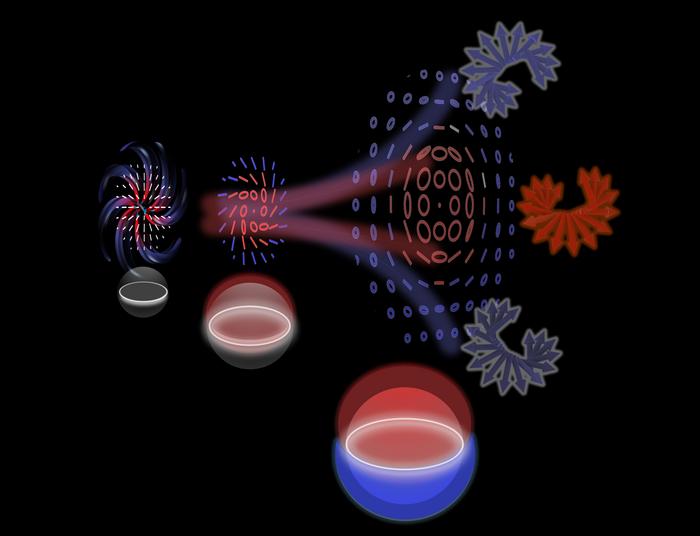
The discovery overturns decades of scientific thinking and reveals that light can develop what is called “chiral” behaviour — meaning it can act like a left or right hand — while travelling freely through space. Until now, producing this kind of light required expensive, precision-engineered equipment. This discovery shows it can happen naturally, simply by preparing light in the right way.
Why Should You Care? Here’s the Real-World Impact
This is not just a laboratory curiosity. According to the Wits research team, this work could lead to simpler and more sensitive medical tests, especially in drug development. It could also be used to pack more information into laser beams — boosting data capacity for communications, including future quantum networks.
To understand why that matters: many life-saving medicines depend on the ability to distinguish between left and right-handed molecules. Chirality is a crucial concept in science — many molecules, including those used in medicines, come in left and right-handed forms that look almost identical but can behave very differently inside the human body. This discovery offers a simpler, cheaper way to do exactly that kind of testing.
For everyday people, the communication implications are just as significant. Faster internet. More secure data. Better quantum networks. Because the effect doesn’t rely on fragile materials or precision-engineered surfaces, it could be easier and cheaper to use in real-world technologies.
One of the key experimenters in this study is Light Mkhumbuza, an MSc student at Wits University’s School of Physics. As Mkhumbuza describes it: “It starts off with no spin at all. But as the beam travels forward, spinning regions appear and separate out — almost as if the spin was hiding and then revealed itself.”
His supervisor, Dr Isaac Nape of the Wits School of Physics, explains the science behind it using an analogy we can all follow. “To explain it, imagine a mug and a doughnut — you can morph one into the other without tearing it, because they both have one hole. Light has its own version of this ‘hole count’ — a hidden topological fingerprint buried in the way its polarisation is arranged.” It is this fingerprint that guides how light behaves as it travels.
These are young South African scientists working at the frontier of global research. That alone is worth celebrating.
What this means for young south africans
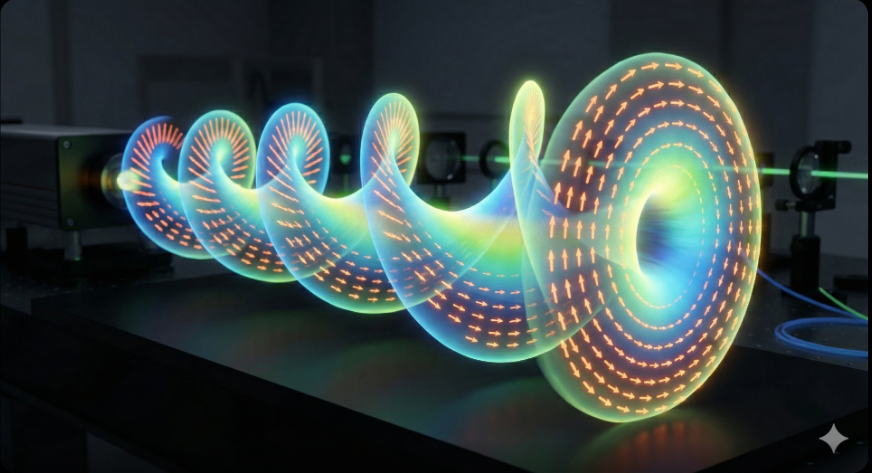
If you are a young person reading this and wondering where the opportunities of the future lie — pay attention to what is happening at institutions like Wits. Fields like photonics, quantum physics, optics, data science, biomedical engineering and materials science are going to define the next industrial era. The careers of the future will not just be in coding — they will be in the labs, the research centres and the innovation hubs where breakthroughs like this one are born.
South Africa has the minds. This discovery proves it.
We will be following this story
The researchers themselves say their work challenges long-held assumptions about what light can and cannot do on its own: “For something so familiar, light is proving to be far richer, stranger and more powerful than anyone imagined. This new behaviour has been there all along — just waiting to be seen.”
We will be following this story closely as this research develops and moves toward real-world application. When South African science makes global waves, our readers deserve to know about it — in language that makes it real and relevant to all of us.
Watch this space.
Original research reported by Wits University. Full article available at wits.ac.za